BEHIND THE FACADE
The theme of the staged, scenographic reality of architecture emerges "Behind the Facade" project, 2012.
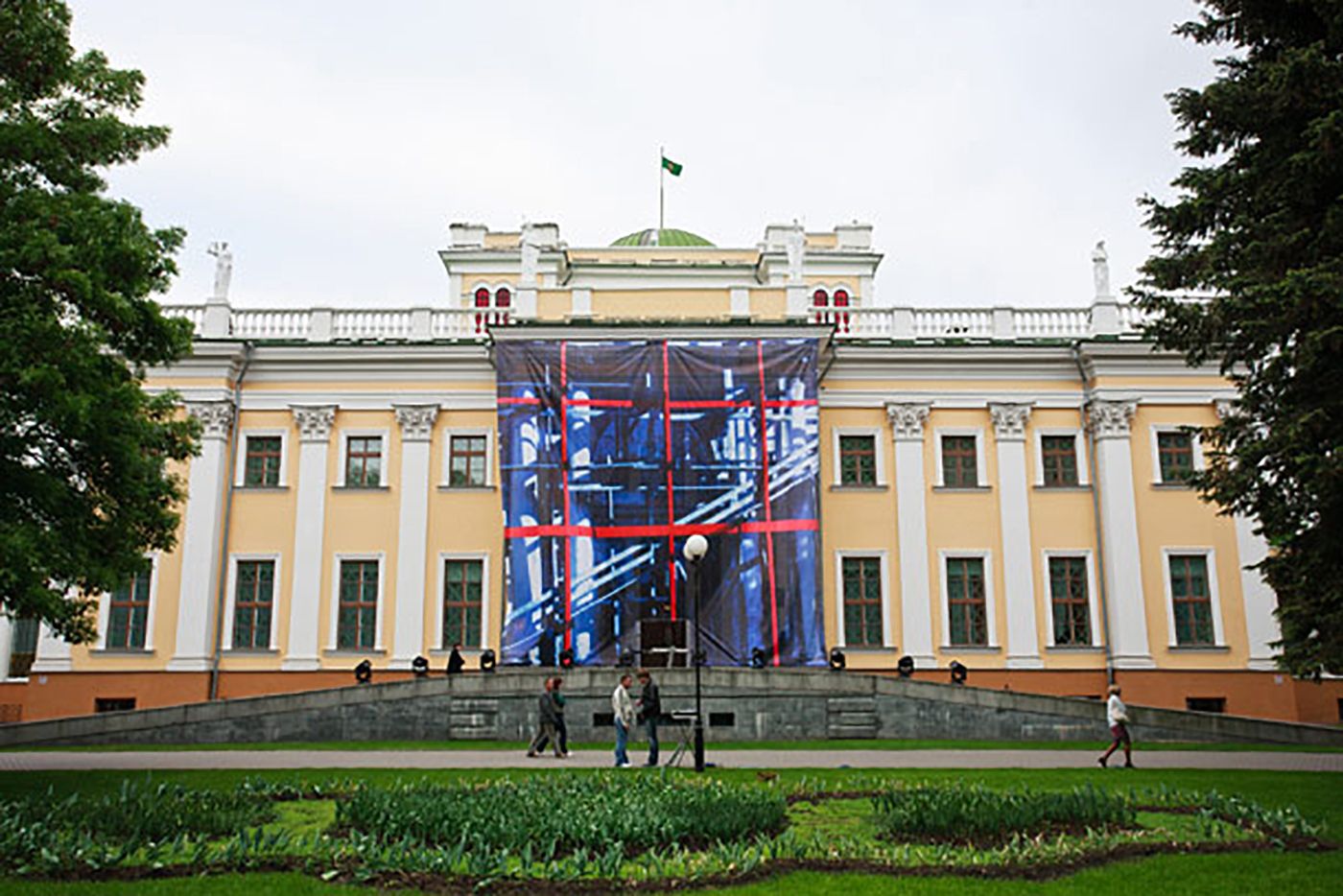
During reconstruction, the building is often represented in a future, restored form, printed on a banner mesh stretched across the façade.
The project's goal is to actualize the binary positions of the historical and the everyday, document and fiction, plane and depth.
This project uses a technology for image production and representation: large-format printing on a 12.7 x 11.4 m banner mesh.
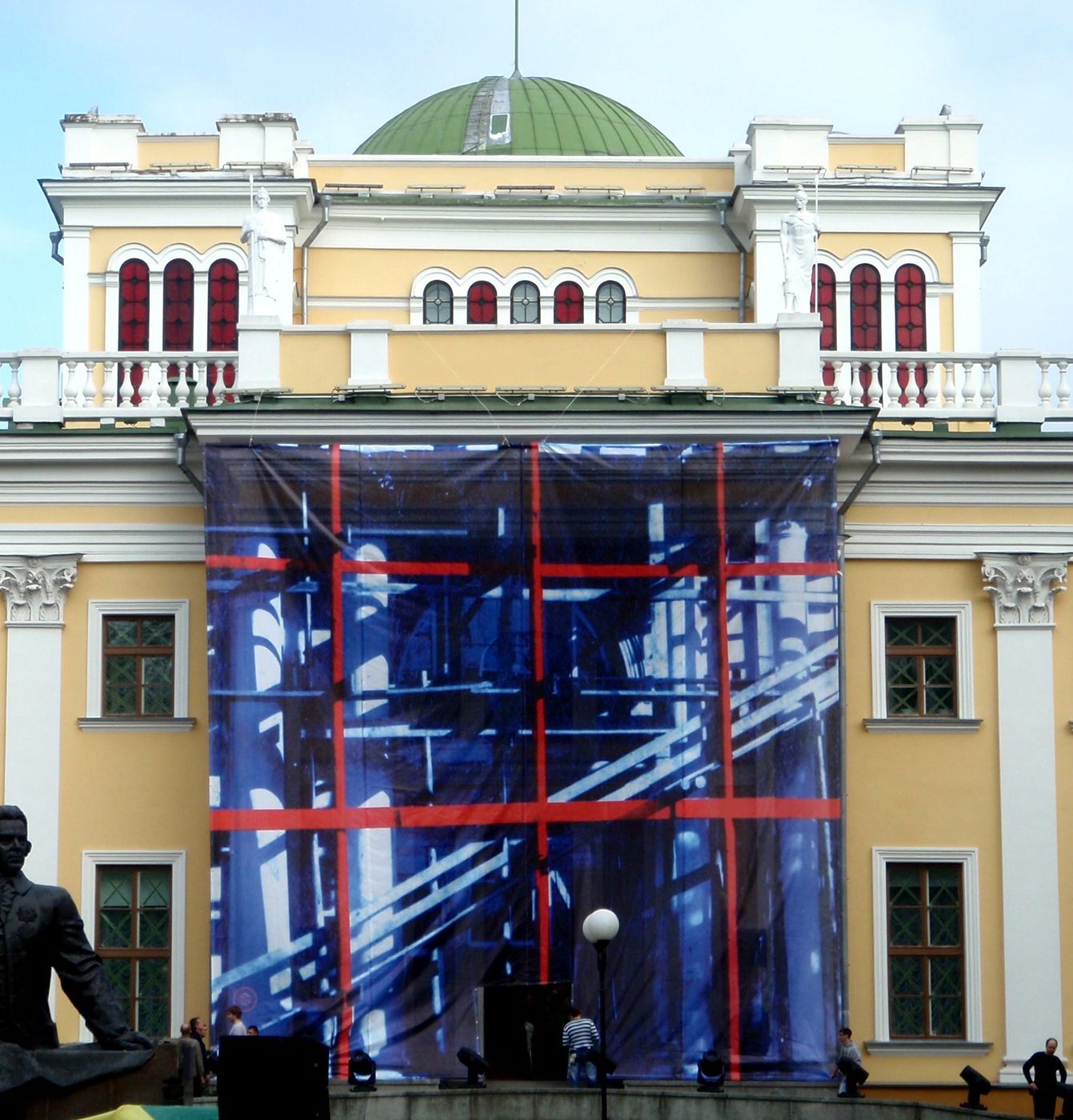
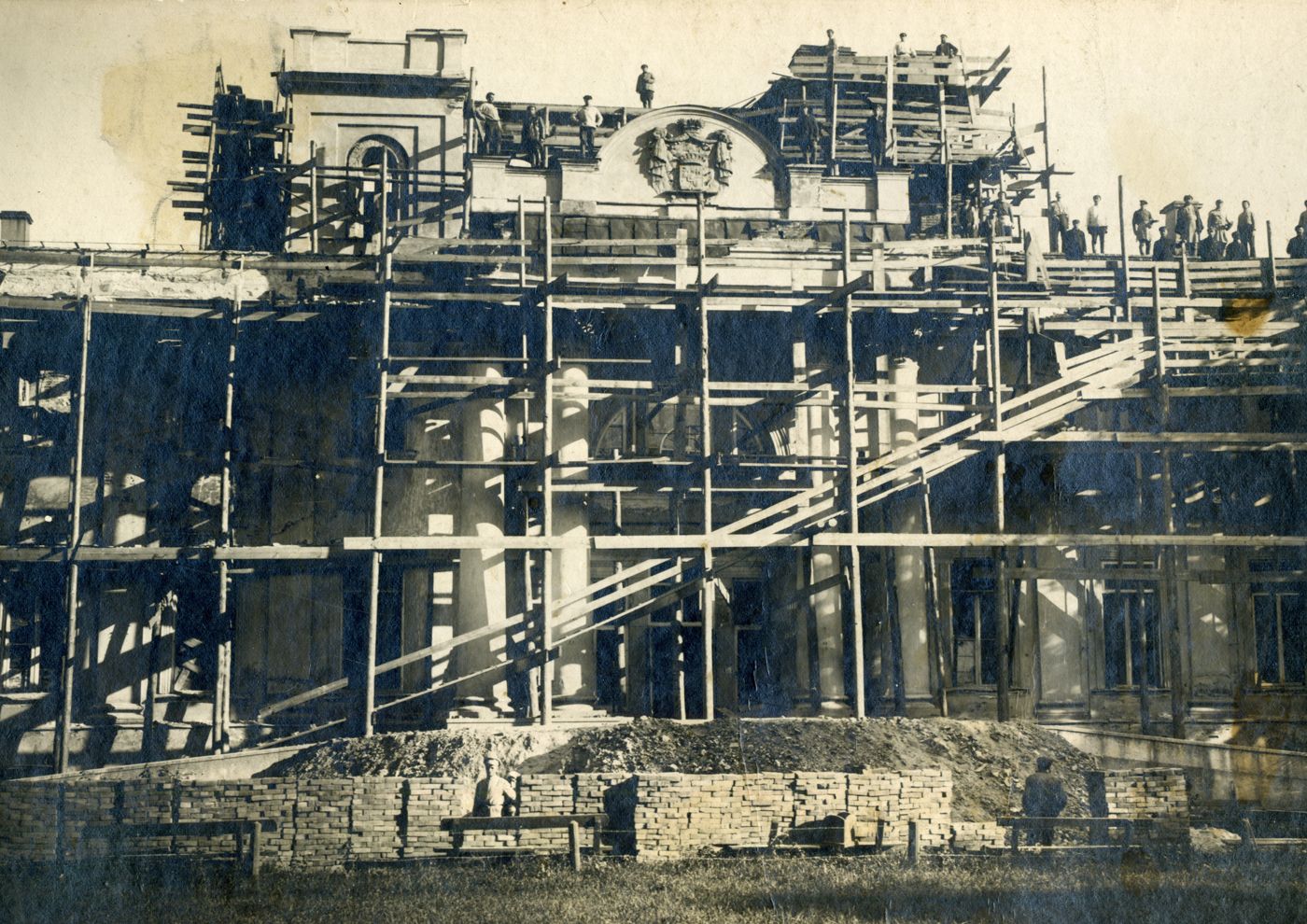
The original visual material was an archival photo from the 1920s—the Paskevich-Rumyantsev Palace (Gomel) in scaffolding, a restoration of the aftermath of the Revolution. The photograph condenses historical reality into a small, flat surface. Enlarging its fragment in the installation to the size of a façade banner unpacks this compressed reality and transforms it into its original architectural scale. A virtual image of the reconstruction overlays the current façade, evoking the multi-layered nature of the architectural structure. Another layer—historical, architectural, metaphysical—is "implanted" into the architectural space of the palace and park complex.
The frontal parts of the scaffolding are marked in red. They belong to the surface of the image and yet stand apart from it. The red scaffolding lattices, moving into the foreground, act as an architectural structure, simultaneously creating distance from the image, evoking its illusory nature.
During reconstruction, the building is often represented in a future, restored form, printed on a banner mesh stretched across the façade.
The project's goal is to actualize the binary positions of the historical and the everyday, document and fiction, plane and depth.
This project uses a technology for image production and representation: large-format printing on a 12.7 x 11.4 m banner mesh.
The original visual material was an archival photo from the 1920s—the Paskevich-Rumyantsev Palace (Gomel) in scaffolding, a restoration of the aftermath of the Revolution. The photograph condenses historical reality into a small, flat surface. Enlarging its fragment in the installation to the size of a façade banner unpacks this compressed reality and transforms it into its original architectural scale. A virtual image of the reconstruction overlays the current façade, evoking the multi-layered nature of the architectural structure. Another layer—historical, architectural, metaphysical—is "implanted" into the architectural space of the palace and park complex.
The frontal parts of the scaffolding are marked in red. They belong to the surface of the image and yet stand apart from it. The red scaffolding lattices, moving into the foreground, act as an architectural structure, simultaneously creating distance from the image, evoking its illusory nature.
ARTIFICIAL SELECTION
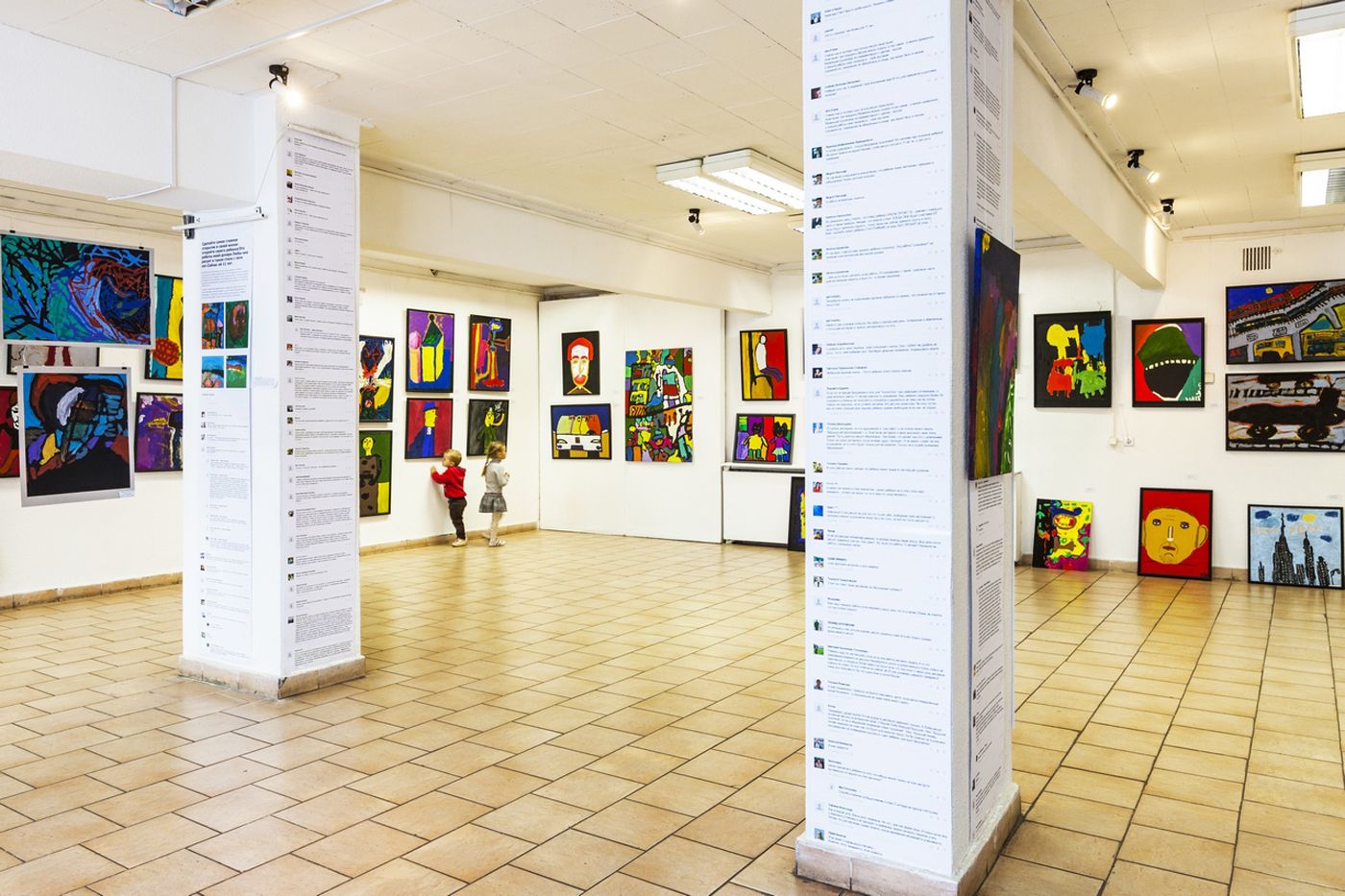
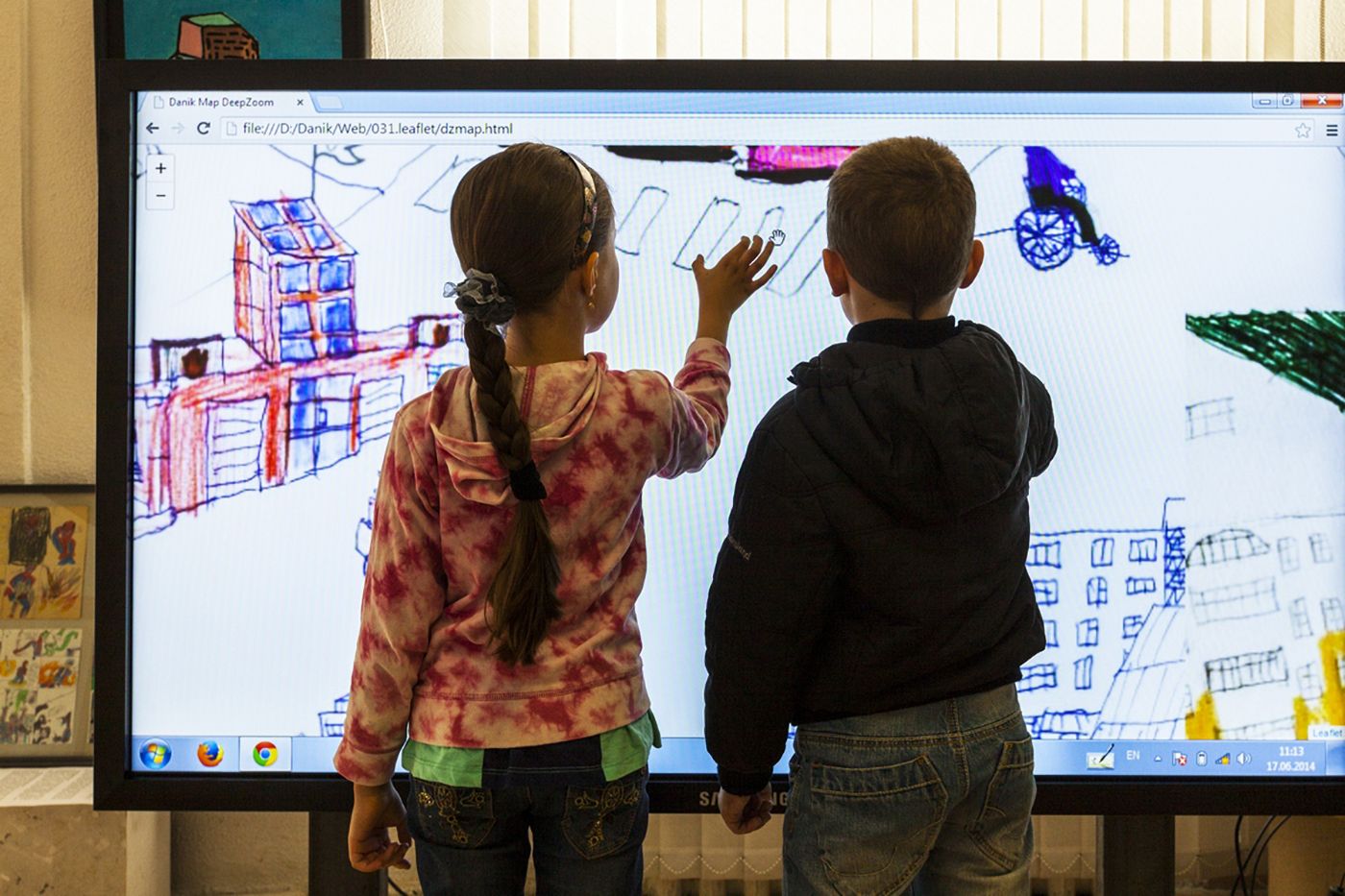
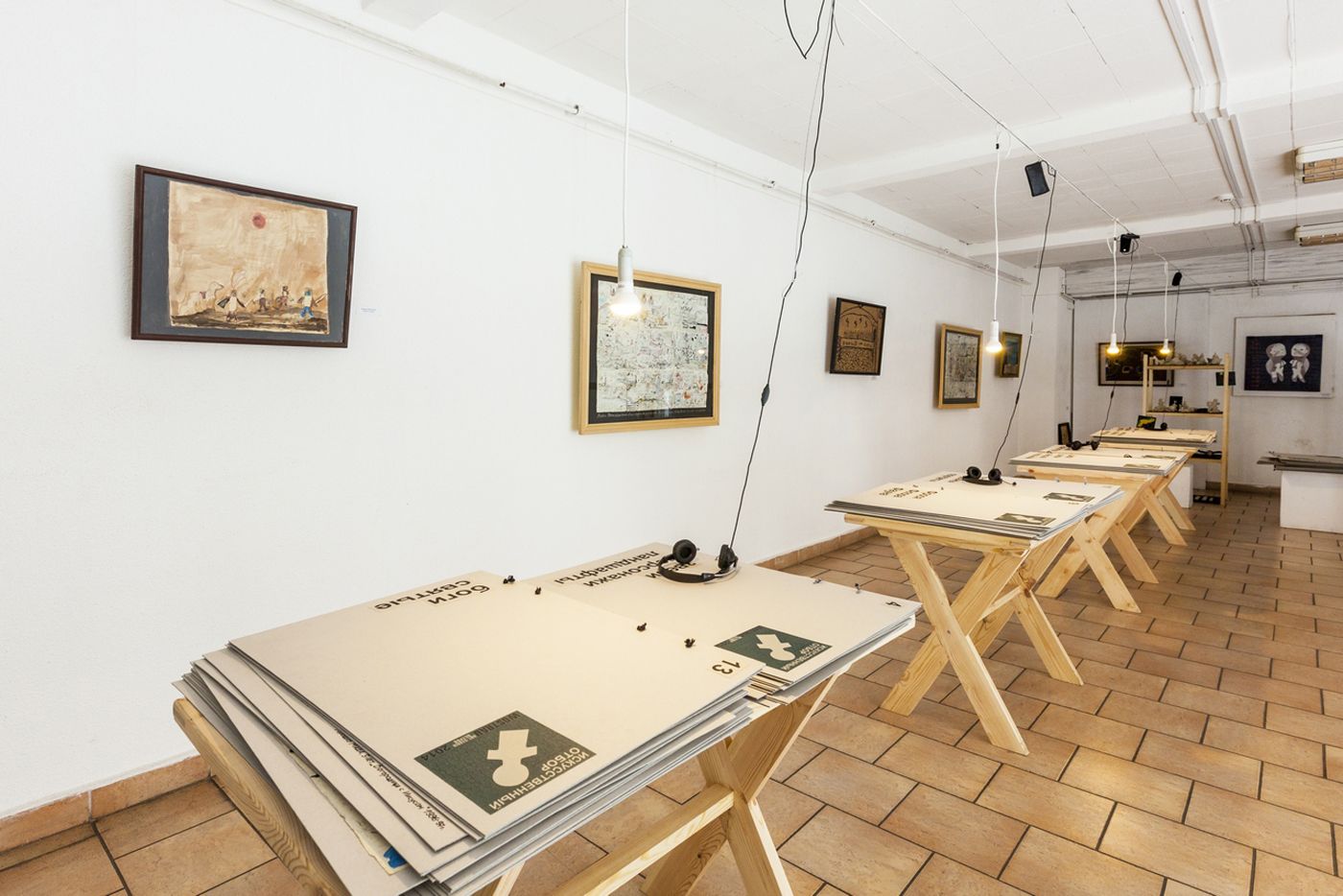
Сo-curator (with Yu. Ivanov and I. Sarnatskaya) of the "Artificial Selection" project at the Museum of Modern Fine Arts in 2014, dedicated to the 20th anniversary of the Wostrau art studio. The exhibition will feature a variety of contemporary visual art forms: painting, drawing, installations, video and audio documentation, including over 200 artifacts created by the studio's students, reflecting the perspectives of several generations of children at the turn of the century.
The atmosphere of the art studio—a place where, for many years, children were given unconditional creative freedom—was recreated in the Museum's halls. The "Artificial Selection" project is also an attempt to address a number of socio-cultural phenomena arising from the interaction between two worlds—children and adults.
The atmosphere of the art studio—a place where, for many years, children were given unconditional creative freedom—was recreated in the Museum's halls. The "Artificial Selection" project is also an attempt to address a number of socio-cultural phenomena arising from the interaction between two worlds—children and adults.
"CHILDISH. HIDDEN"
The "Childish. Hidden" project, September 2013. Co-curator of the project with A. Sharko and I. Sarnatskaya.
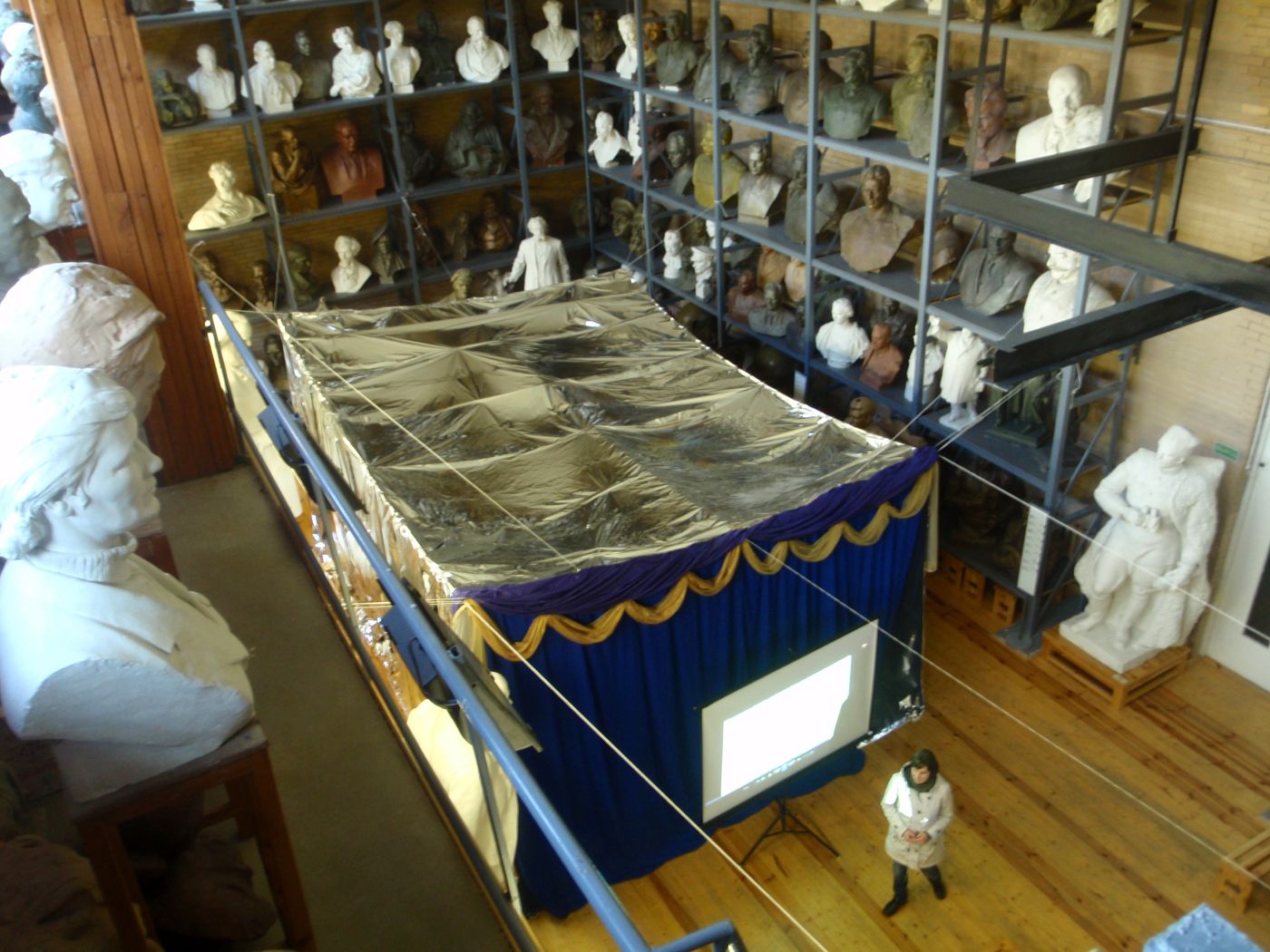
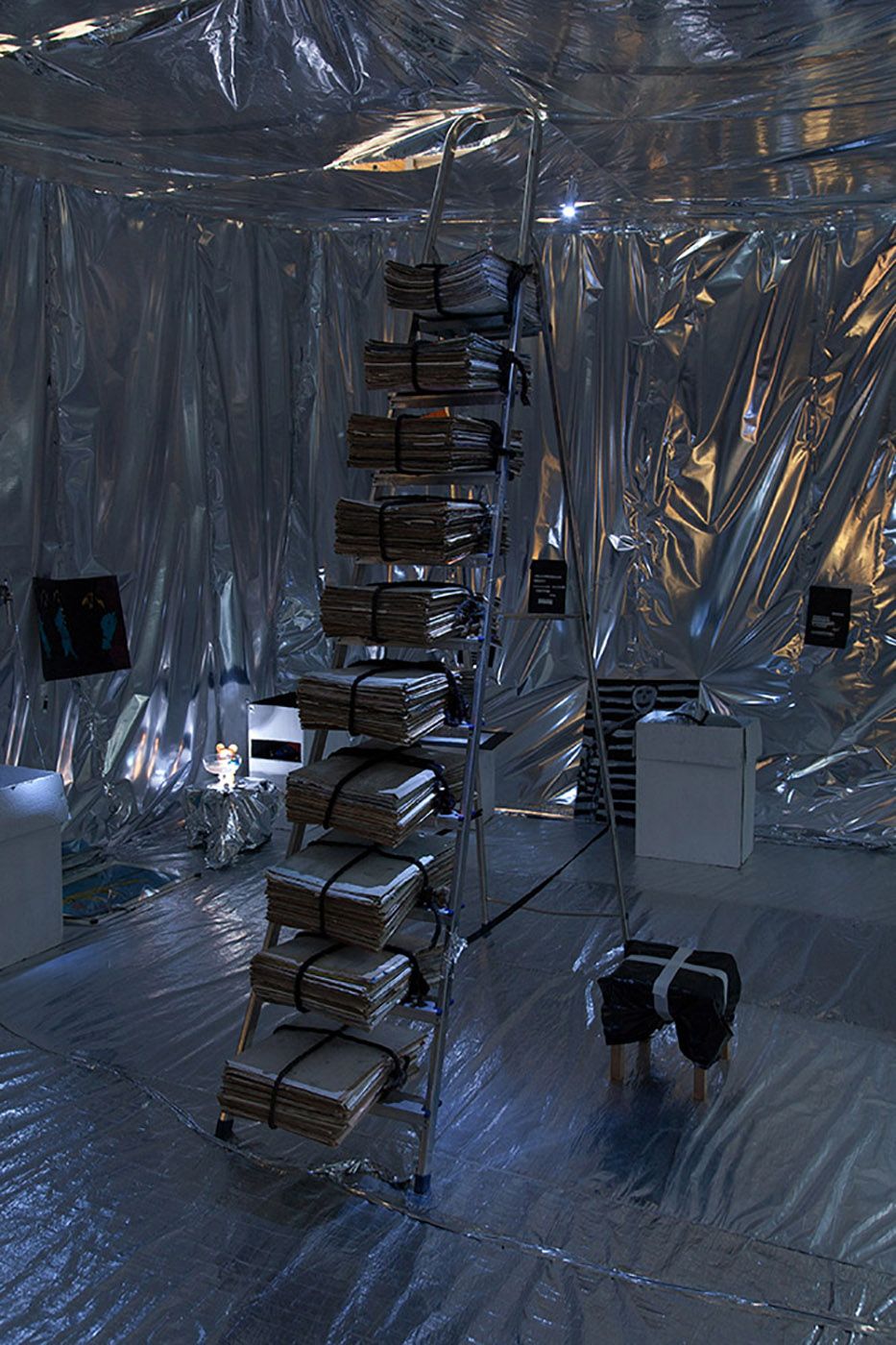
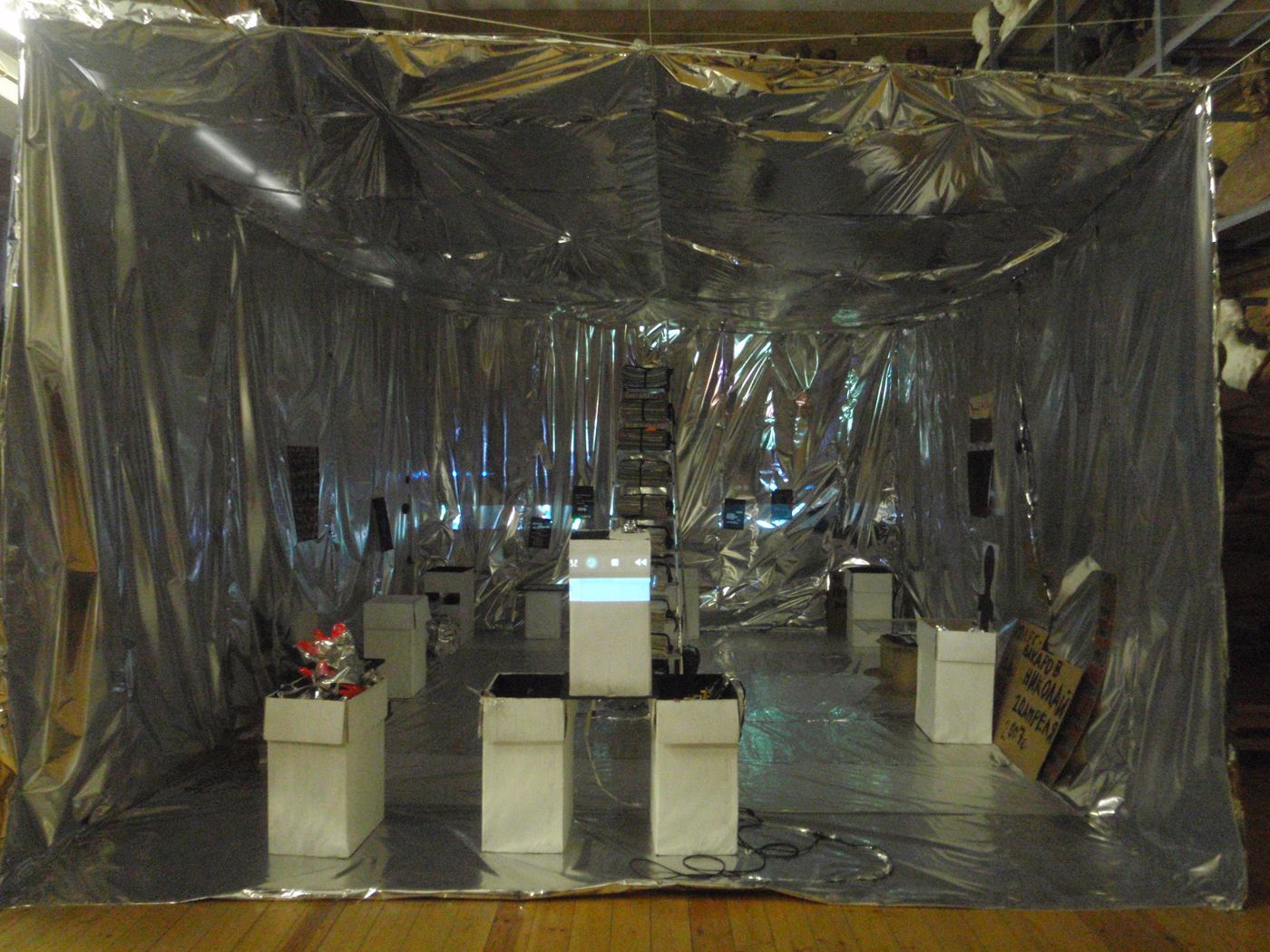
The project was structured as an "exhibition within an exhibition" in the large hall of the Z. Azgur Memorial Museum and Studio. Surrounded by the permanent exhibition of casts of Soviet-era heroes, a foil pavilion was housed, its façade a curtain with a video projection of statistical data on children's health, education, and so on. The pavilion's interior was organized like a storage facility. The central object was part of the Wostrau studio's archive (folders with drawings). Art objects were housed in boxes resembling half-open parcels. They were placed in a foil-lined environment (foil is known to have preservative properties) to prevent the harmful effects of the natural and social environment. They remained there until needed—when the moment came for the grown child to access their archive, and thus their forgotten, hidden essence. In the corners of the pavilion, one could listen to audio recordings of children's candid stories.
Children often don't regard their creativity as art. For them, it is a syncretic activity, inextricably linked with other aspects of their lives, which makes them akin to prehistoric peoples, outsider artists, folk craftsmen, and so on. Therefore, artifacts of children's activity often escape the superficial, momentary gaze (even of teachers and parents). For the project's authors, such artifacts are found objects (objet trouve) plucked from the flow of time.
The project was structured as an "exhibition within an exhibition" in the large hall of the Z. Azgur Memorial Museum and Studio. Surrounded by the permanent exhibition of casts of Soviet-era heroes, a foil pavilion was housed, its façade a curtain with a video projection of statistical data on children's health, education, and so on. The pavilion's interior was organized like a storage facility. The central object was part of the Wostrau studio's archive (folders with drawings). Art objects were housed in boxes resembling half-open parcels. They were placed in a foil-lined environment (foil is known to have preservative properties) to prevent the harmful effects of the natural and social environment. They remained there until needed—when the moment came for the grown child to access their archive, and thus their forgotten, hidden essence. In the corners of the pavilion, one could listen to audio recordings of children's candid stories.
Children often don't regard their creativity as art. For them, it is a syncretic activity, inextricably linked with other aspects of their lives, which makes them akin to prehistoric peoples, outsider artists, folk craftsmen, and so on. Therefore, artifacts of children's activity often escape the superficial, momentary gaze (even of teachers and parents). For the project's authors, such artifacts are found objects (objet trouve) plucked from the flow of time.